Dante (Digital Audio Network Through Ethernet) has become one of the most important technologies in modern professional audio. From live sound and broadcast to recording studios and large-scale installations, it has quietly reshaped how audio is routed, distributed, and scaled. Here’s a clear, practical look at what Dante is, where it came from, and how we use it day-to-day at Headliner.
What Is Dante?
At its simplest, Dante is a protocol for transporting high-quality digital audio over standard Ethernet networks using off-the-shelf, managed network switches. Crucially, it isn’t tied to any single manufacturer. Today, Dante is supported by thousands of products from hundreds of brands, allowing devices from different manufacturers to coexist on the same network.
The name Dante comes from the Italian word meaning enduring or steadfast, made famous by poet Dante Alighieri. In many ways, that description fits: Dante has proven itself to be a robust, scalable, and a long-lasting solution. In practical terms, however, Dante is best remembered by what it actually does — Digital Audio Networking Through Ethernet.
A Brief History
Dante’s origins date back to 2003, when Motorola closed its Australian research facility. Former Motorola engineer Aidan Williams assembled a team at Australia’s National ICT research centre (NICTA) in Sydney. With government funding, they spent several years developing the foundations of what would become Dante.
In 2006, Williams founded Audinate to bring the technology to market. Two years later, Lee Ellison joined as CEO to drive commercial adoption, and Audinate opened a US headquarters in Portland, Oregon.
A major turning point came in 2012, when Yamaha adopted Dante for its CL series digital consoles. Yamaha recognised the value of a protocol capable of handling uncompressed, low-latency audio across multi-manufacturer systems with large, scalable channel counts. Around the same time, Focusrite introduced Dante into its RedNet range, not only for flexibility but also for its reliability and sound quality.
Since then, Dante has evolved beyond audio alone and is now a fully fledged AV-over-IP platform, capable of transporting both audio and video across IP networks.
Key Features
Today, Dante is available in well over 4,000 products from more than 500 manufacturers. It supports high channel counts of up to 1,024 channels (512 x 512) and can achieve latencies as low as 150 microseconds, making it suitable for real-time audio applications.
Dante networks are highly scalable and flexible, allowing systems to expand or reconfigure using existing network infrastructure. Devices automatically discover one another on the network, while built-in clock synchronisation ensures phase coherence and consistent audio quality across all connected equipment.
For these reasons, Dante has become the most widely adopted networking protocol in professional audio, spanning live sound, broadcast, studios, and commercial installations such as schools, universities, and performance venues.
Dante in the Studio
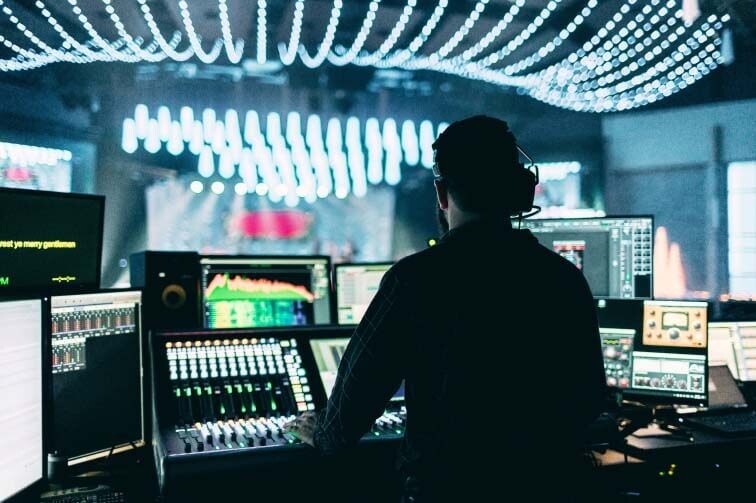
At this point, it’s useful to look at why Dante became the obvious choice for Headliner’s own studio facility. When plans for the studio were first discussed around three years ago, several constraints shaped the design. The building also housed a live music venue, and the ability to capture multichannel audio feeds from the venue into the studio presented a clear commercial opportunity.
Dante allowed us to move multichannel audio to the studio DAW over a single Cat6 cable, initially making sense from both a technical and cost perspective. The venue’s front-of-house console — a Soundcraft Vi1000 — ships with a factory-fitted Dante interface, making integration straightforward.
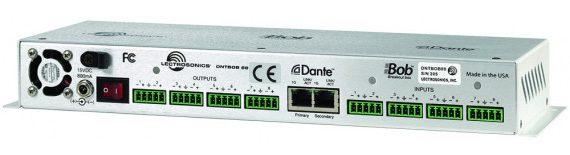
At the time, we also owned a pair of Lectrosonics BOB-88 units (pictured below), high-quality eight-in, eight-out line-level Dante converters. These proved ideal for handling 16 channels of tracking from the SSL desk, as well as playback for the Genelec Atmos monitoring system.
Since then, the Dante network has expanded considerably. Additional devices now include a Neve 1073OPX for alternative mic-pre flavours, a Prism Sound Dream ADA-128 as the primary conversion stage, a Harrison Audio D510r 500-series rack with switchable analogue and Dante operation, and a collection of Audinate AVIO adaptors.
The AVIO units, in particular, are invaluable. They effectively act as a ‘get out of jail free’ card, allowing quick analogue or USB integration where needed. It’s worth noting that the analogue AVIO break-in and break-out adaptors require Power over Ethernet on the port they’re connected to, while the USB-C and USB 2.0 variants can be powered directly from the connected computer. These USB adaptors have been especially useful for visiting producers and management who simply want to monitor stereo playback through the Genelecs
Dante in Live Sound
My own experience with Dante in live sound dates back to 2012, working on a touring theatre production that had recently invested in Dante cards for a pair of Allen & Heath iLive consoles. Dante was used not only for multitrack recording, but also to distribute audio from a laptop running QLab, and to share audio between stage racks.
Initially, the system ran in switch mode, allowing laptops to be daisy-chained for recording and playback. As the production evolved, redundancy was introduced using managed switches and virtual networks — one dedicated to Dante and another for OSC control. While the system was relatively simple by today’s standards, it provided an excellent grounding in audio networking and network administration.
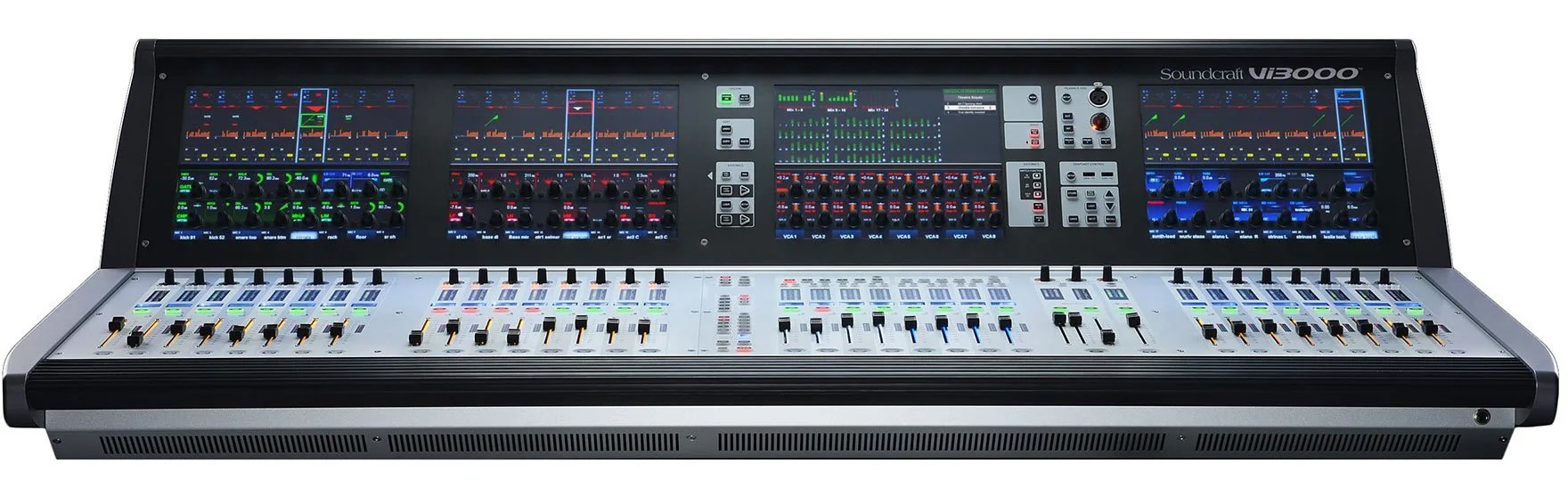
A few years later, the monitor console was upgraded to a Soundcraft Vi3000 (pictured below), again with Dante built in as standard. This not only improved on-stage sound quality thanks to better preamps, but also delivered noticeable improvements at front of house. The ability to use different consoles while maintaining an integrated, shared audio system remains one of Dante’s biggest advantages — alongside a dramatic reduction in cabling.
Today, many touring and rental systems we support feature Dante-enabled devices as standard. From Fourier Audio processing engines and Shure Axient wireless systems to Sennheiser Spectera and DiGiCo consoles, Dante has become a near-universal digital audio language.
Practical Networking Advice
One of Dante’s biggest strengths is its use of readily available network hardware. In our experience, inexpensive managed switches such as Cisco’s SG300 or SG350 ranges work extremely well. While Dante can function on unmanaged switches with Energy Efficient Ethernet (EEE) disabled, managed switches unlock additional stability, reliability, and control.
Best practice includes assigning static IP addresses to switches so they remain easy to identify as the network grows. Creating a dedicated VLAN for Dante traffic also helps keep audio data isolated from control and general network traffic.
Managed switches should support DiffServ (DSCP) Quality of Service with strict priority and four queues. Clock synchronisation traffic should be given the highest priority, followed by audio PTP traffic, with control and miscellaneous data handled at lower priorities. This ensures timing-critical audio data is always delivered reliably.
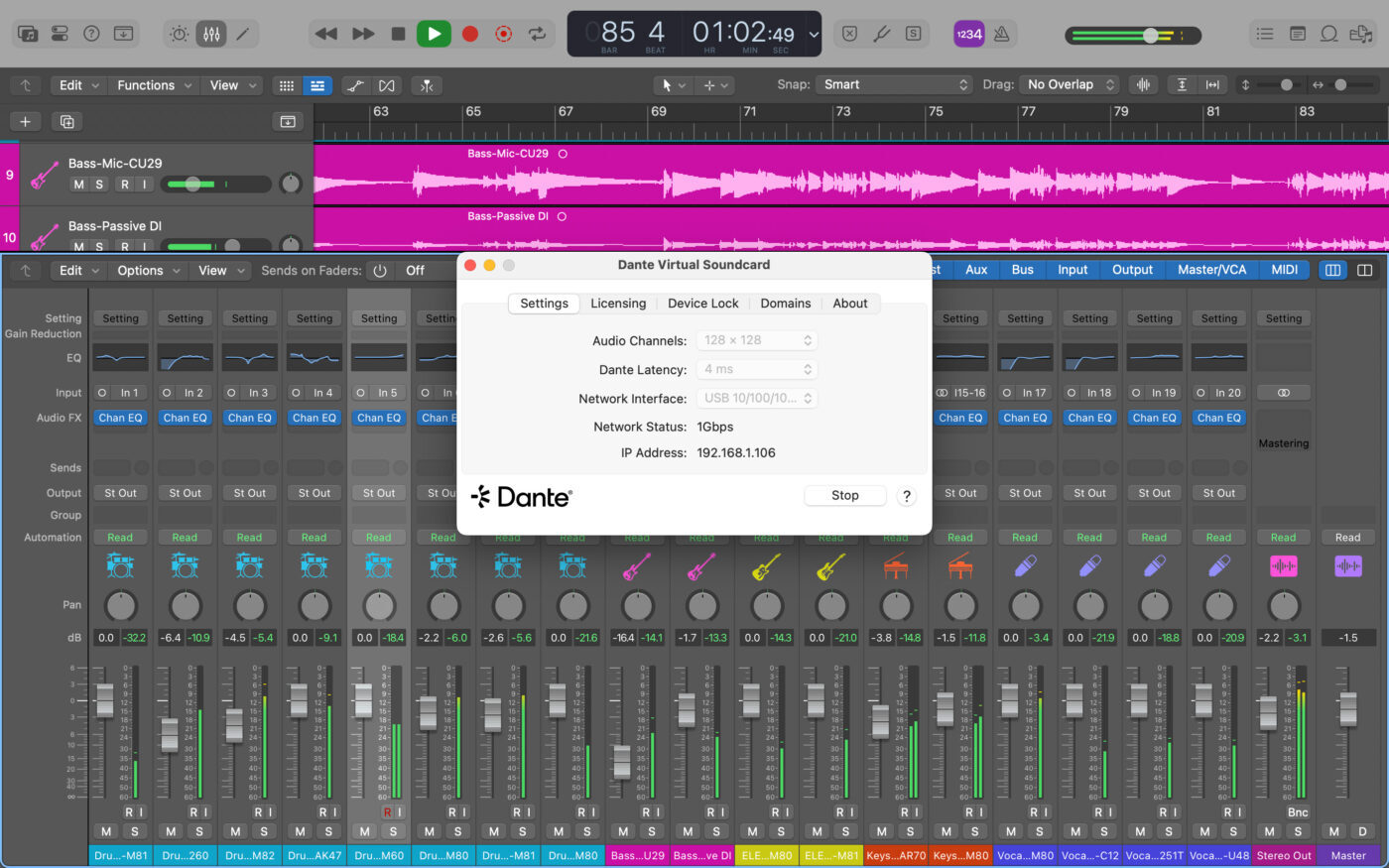
One often overlooked detail is the use of Dante Virtual Soundcard. I highly recommend using a computer’s physical Ethernet port rather than a hub-based adapter. On Mac systems, an official Apple Thunderbolt-to-Ethernet adapter is strongly recommended. If using multiple switches, configuring trunk ports allows both control and VLAN traffic to pass between switches over a single Cat6 cable with minimal latency — as low as 0.15 milliseconds
Final Thoughts
Dante offers far more advantages than drawbacks. While you don’t need to be a qualified network engineer to deploy it successfully, a solid grounding in basic networking principles will make life much easier. Audinate’s Dante training and accreditation programmes are well worth exploring for those new to the platform.
Once you understand how Dante works, it quickly pays dividends — delivering flexible, scalable, low-latency audio networking that would have been unthinkable only a decade ago.