

Subscribe
Studio

How Mark Slee’s studio is making experimental immersive audio accessible to artists

Mark Slee, a DJ and producer who is known for unique projects that focus on the intersection of light, immersive sound and technology, talks about his route into spatial audio and what led him to open a Genelec monitoring audio space in Sussex that encourages people to delve into immersive audio in a more exploratory context...

What were your early interests in terms of music and technology?

I got bitten by the electronic music bug in my early teenage years listening to Aphex Twin, Orbital and all that sort of stuff. That sent me down the rabbit hole. I'd also already been interested in computers – my dad did a lot of work with computers – so we had one in the house from a fairly young age, and those two combined pretty naturally. 

This was also the age of file sharing and Napster – the internet just coming online so there was this total explosion of the amount of music that could be discovered and explored. It was very fortunate timing for me in my teenage years; I had a massive appetite for as much as I could wrap my head around, and that pretty much just stuck.

I got bitten by the electronic music bug in my early teenage years.


This was also the beginning of the explosion of Freeware plugins and those early synth tools and drum machines that could run on a computer, so I dove into that. At the same time I got really curious about how all these sounds were being made and how it worked, and I never looked back.

Technology-wise, my formal education was I carried on in the same direction and went to university at Stanford in California and got degrees in computer science and mathematics. They're not so specifically music-focused, but that overlap between the two was always in the background.

You are heavily involved in exploring the potential of immersive audio. Can you remember your first experience with immersive audio? What immediately struck you about the possibilities that lay within immersive audio at that time?

That's a good question. The short answer is there's not a singular one that pops out in my mind! The obvious thing would have been early cinema experiences. In a way it’s sort of gone backwards; in the ‘90s, with home theatres it was this massive thing that everyone was trying to put multiple speakers in their living room, or at least that was being heavily marketed. I remember in high school, at home I got a little 5.1 receiver and set that up in my bedroom. So those are the basic first experiences.

It was really with the work I do now with Envelop [since 2016 Slee has been developing immersive, spatial audio-visual production tools for systems of up to 32 channels] that came about in the mid 2010s. Some of the pivotal experiences there were hearing some Ambisonics systems in San Francisco that people had set up. 

There was a 12-channel Ambisonics rig that was a sort of cube with speakers mounted around the outside of the cube that you could stand in the middle of. They had various Ambisonics field recordings of different material and that was a different way of experiencing that that pulled it out of the cinema context – putting the sound front and centre really is the core experience. That's when I got more interested in it in terms of realising there's this whole other kind of potential.

Are you tapping into the musical, artistic or the mathematical, precise side of your brain in your approach to immersive work?

A bit of both. The work that I do with Envelop and the tools that we make there are all based upon Ambisonics technology, but there's so many different approaches to immersive audio. I think that both approaches help, but it also can be a bit of a crutch sometimes to be an engineer.

The strength, obviously, is if I have an idea, I can go and play with it, work on the implementation myself and try to build it without layers of trying to express the idea and specify it. I think sometimes there's a drawback actually, in that you as an engineer and implementer are too aware of what's easy to do, technically, and what's difficult to do, technically.

So you end up with this natural bias to do things in the way that makes it elegant to implement, which doesn't necessarily always map cleanly to what is going to be the way that an artist is going to want to use it, or what the musician wants it to do. So I just try to keep that in mind to optimise it for the user experience in the end.

immersive can be ‘chicken and the egg’ in terms of having time for artists to create, but this ties into the question: What's the point of making that?

Recently you’ve opened a space in Sussex with a 17.4 system to allow people to work on immersive audio and visual experiences in a more exploratory context; what can they do here that they couldn’t in a more traditional immersive space?

It's really about setting up the time to experiment. What we've observed with Envelop is that (and it's not Envelop-specific but immersive in general) it can be a bit of a ‘chicken and the egg’ problem in terms of the cycle between having time and space for artists to really explore and create content in immersive, but then this ties into questions of, ‘What's the point of making that? Where is an audience going to experience it? Where is it gonna be presented?’

There's a couple of trends recently that are showing a lot of promise here. One is the broader distribution of Atmos, and that is starting to go into things like Apple Music and some more mainstream commercial avenues.

The other one has been the adoption of Ambisonics by a lot of the virtual reality platforms and YouTube 360 videos. There's signs that are very positive that could point to this getting easier and easier to do, and there being more of it. What we see with Envelop is artists that are on a lower tier – not major artists that are doing major release work – asking, ‘How accessible are the tools? Why is it worth the time to do it? Is there time available to work on it somewhere?’

There's certainly plenty of project studios out there that have Atmos mixing rooms, but they tend to be more of the traditional studio time mode, which is not necessarily the most accessible if you just want to spend loads and loads of hours messing around with sound design.

My hope with this space is to have a studio available that's not bound by needing to be constantly producing work of that sort, and hopefully be able to invite people in and connect that back, either to Envelop or potentially to other future venues in parallel. Our hope has always been that there could eventually be a network of spaces where immersive audio experiences can be presented and shared.

there's a drawback that as an engineer you are too aware of what's easy to do, technically, and what's difficult to do.

You always knew you wanted a Genelec-based monitoring system for this space (the room boasts a system built around 17 8351B coaxial monitors supported by four 7380A subwoofers); what made you so certain you wanted Genelecs?

Genelec’s reputation for studio monitoring is outstanding and the GLM tools made it so clear that that was gonna save so much time and make the room correction so much simpler; that can always be just such a time sink and a difficult problem to solve. 

Especially when you try to do it manually. For me, it was those two things and just knowing that if I invest into this, the odds of me regretting it from a sound quality point of view are close to nil. The GLM stuff is a huge advantage and is so simple to use. I was very pleased with that.

he odds of me regretting getting genelecs from a sound quality point of view are close to nil.

Given that this is an unusual space and not a traditional acoustically-treated recording studio, how much of a difference did the GLM software make?

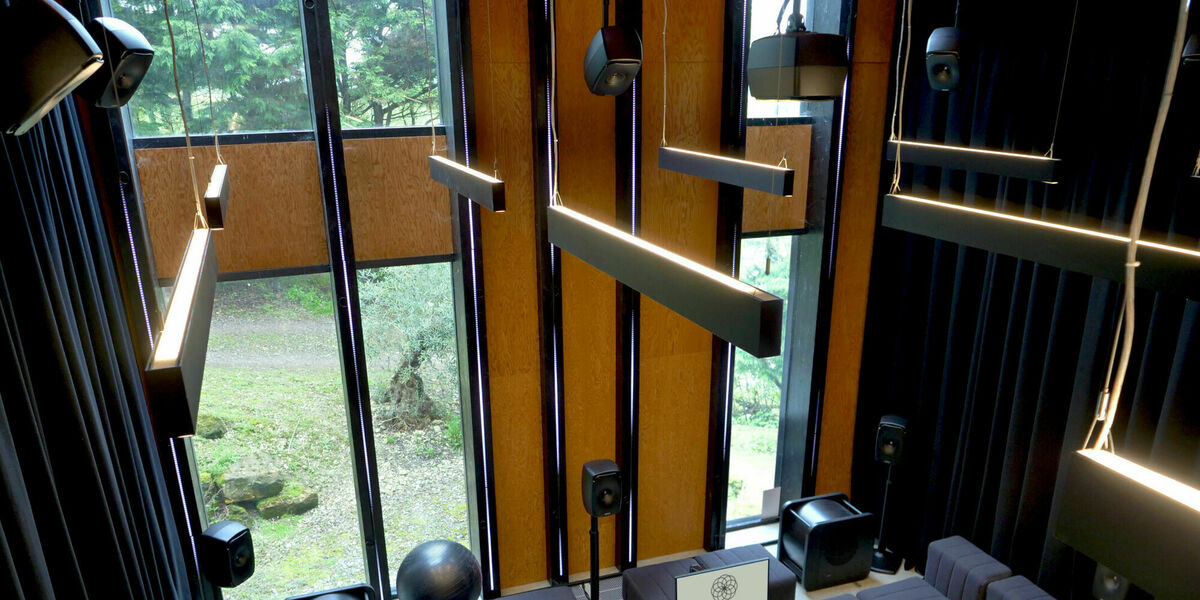
That was absolutely something I was trying to balance because the room is very architecturally beautiful – it has high ceilings and windows out of which you can see the countryside and greenery – so I didn't want to kill that. I’m thinking about artists working here and that's very much part of the experience, that sense of place and relaxation. But then couple that against the fact that it is a rectangular box room with some glass and hard surfaces and there’s loads of things about that that aren't acoustic ideal.

I put in heavy acoustic curtain treatments on two of the main walls, which made a big difference but the GLM made a huge difference in terms of the remaining room modes, especially with it being rectangular. Of course there are always going to be resonances in the room and fundamental modes. With GLM you can go in and see what it's done for each speaker in terms of the EQ curves and the time of arrival.

In an ideal Ambisonics setup, you try to place your speakers on the surface of a virtual sphere so they're all exactly the same distance from the listening position. But this is almost never realistic in practice, of course. So time of arrival compensation does matter a fair bit on these speakers.